

When it comes to employee financial wellness, the conversation almost always starts — and ends — with a single solution: the 401(k).
And while retirement plans remain a cornerstone of financial security, here’s the uncomfortable truth: For millions of American workers, retirement savings aren’t just out of reach — they’re out of relevance.
We’ve built our financial wellness strategies around the final stage of the journey, assuming workers have already achieved the financial stability needed to focus on their future. But today’s workforce tells a very different story.
It’s time to expand the conversation — not to replace the 401(k), but to widen the path that helps more people get there.
The 401(k): Designed for Stability, Inaccessible to Many
The 401(k) remains one of the most powerful wealth-building tools available to employees. But it was built for a workforce — and an economy — that assumed:
- Consistent, full-time employment
- Enough surplus income to defer compensation
- Long-term financial stability in a world increasingly defined by short-term survival
That design no longer fits the realities of today’s workforce — especially for the tens of millions earning less than $75,000 per year.
Retirement plan participation drops sharply as income falls:
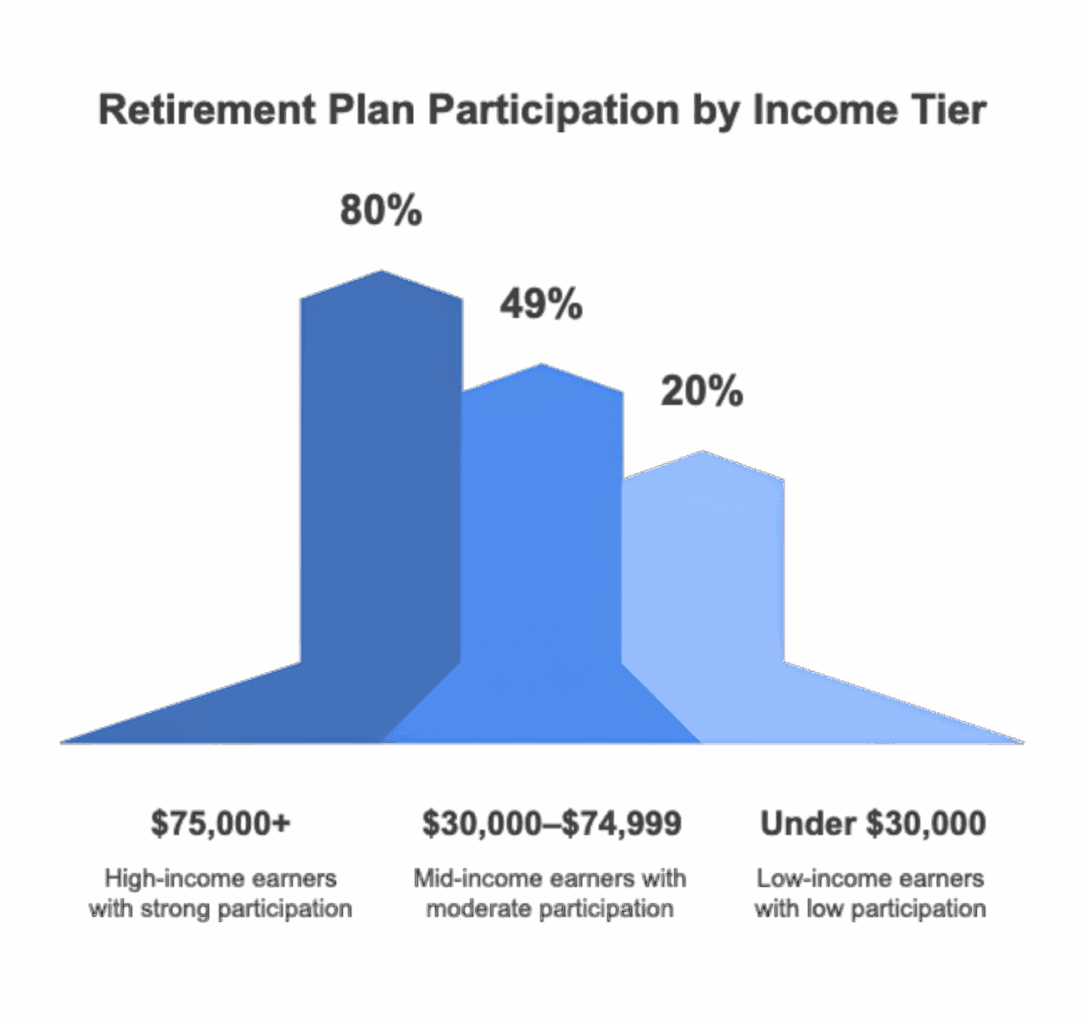
While there are over 100 million retirement accounts in the U.S., only ~60 million are active contributors. That means a substantial portion of workers — particularly in lower- and middle-income brackets — are disconnected from the system entirely.
And 401(k) access remains a major barrier — especially among part-time and hourly workers:
- 57 million working-age Americans lack access to any employer-sponsored retirement plan
- Among part-time workers:
- 80% lack access entirely
- Of the remaining 20% who do have access to a 401(k):
- 81% don’t participate
- 84% don’t receive an employer match
These gaps are both structural and situational:
- Many workers — especially in gig, hourly, or variable-hour roles — are excluded by default
- Others opt out due to cash flow constraints, living paycheck to paycheck
Even those who enroll often contribute minimally due to financial fragility — debt, emergencies, and income volatility
For millions of workers, the 401(k) isn’t just inaccessible — it’s irrelevant until more immediate financial needs are met. Bridging this gap is not just a benefits challenge; it’s a readiness challenge.
Introducing the Retirement Access Ladder
If we want more workers to fully participate in retirement planning, we first have to help them climb toward the financial stability that makes it possible.
The Retirement Access Ladder reframes the challenge, focusing on the structural access employees have to retirement benefits and what they need to move upward.
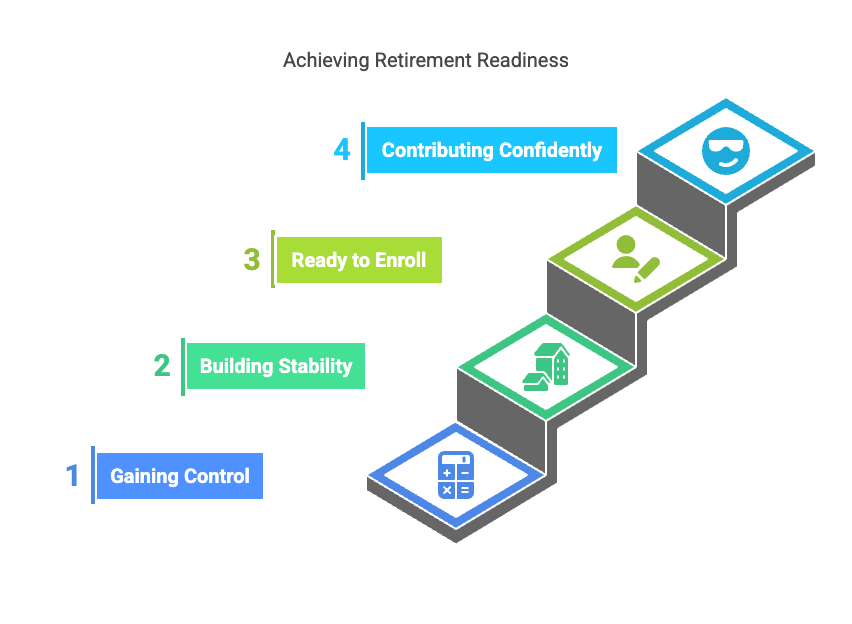
At the top of the ladder, employees are positioned to maximize their retirement opportunities. But for those still on the lower rungs, the focus isn’t retirement—it’s simply making ends meet.
The solution isn’t to move the goalpost of retirement further away. It’s to build stronger steps that help every employee climb toward it.

